

By Gillian Schutte
Every year when China announces its economic plans, a familiar media ritual unfolds. Western wire services scan the documents for any reference to coal and quickly frame the story as a retreat from climate responsibility. The latest coverage of China’s 2026 decarbonisation plan follows this script almost perfectly.
A recent Reuters report by Colleen Howe summarised China’s new five-year plan as a strategy that “stops short of quitting coal.” The piece itself is relatively straightforward reporting. Yet the interpretive frame emerges through the voices chosen for quotation: analysts from Western-aligned climate think tanks who describe China’s carbon-intensity target as “alarmingly lax.”
This framing leaves out the most important context. Climate responsibility is not measured through slogans about coal exits. It is measured through historical emissions, per-capita consumption, industrial structure and the scale of renewable transformation.
Once those elements enter the picture, the story looks very different.
The historical carbon ledger
The central fact rarely foregrounded in Western reporting is historical responsibility.
According to a detailed analysis by Carbon Brief, the United States remains by far the largest cumulative emitter in modern history. By the end of 2024, US emissions had reached roughly 537 billion tonnes of CO₂, about two-thirds higher than China’s historical total.
Research:
https://www.carbonbrief.org/analysis-chinas-emissions-have-now-caused-more-global-warming-than-eu/
In other words, the atmospheric carbon burden driving the climate crisis today is largely the product of industrialisation that took place in Europe and North America over the past century and a half.
China industrialised much later and did so while manufacturing goods consumed across the global economy.
Per-capita emissions tell another story
Total emissions statistics are often used to construct the impression that China is uniquely responsible for climate change. Yet when emissions are measured per person the hierarchy shifts dramatically.
Data compiled by Our World in Data shows:
- United States: about 14 tonnes of CO₂ per capita
- China: roughly 8–9 tonnes per capita
- India: about 2 tonnes per capita
Research:
https://ourworldindata.org/grapher/co2-per-capita
Even after decades of rapid industrial growth, the average American still produces far more carbon than the average Chinese citizen.
Any serious discussion of climate justice must begin with this asymmetry.
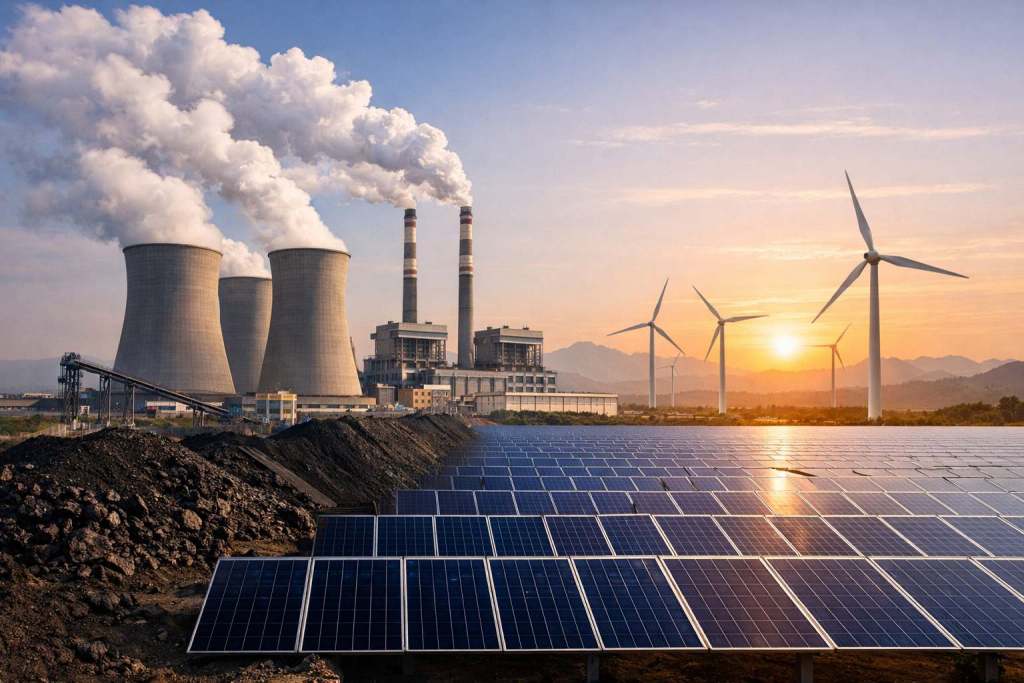
China is already leading the renewable build-out
Another aspect of the Reuters narrative that disappears under the coal headline is the scale of China’s renewable deployment.
China currently possesses the largest installed capacity of wind and solar power in the world, and its expansion rate dwarfs that of any other country. President Xi Jinping has committed to raising combined wind and solar capacity to 3,600 gigawatts by 2035, a target analysts expect China to exceed.
Research:
https://www.iea.org/reports/renewables-2024
China also dominates the global production of solar panels, batteries and electric vehicles. Much of the infrastructure enabling the world’s green transition is manufactured there.
In practical terms, China is both the largest emitter and the largest builder of the technologies required to reduce emissions globally.
Coal in China performs a different role
Western commentary often treats coal as a moral category rather than a structural one.
Coal in China currently functions as a stabilising base-load power source for the world’s largest manufacturing economy. Electricity demand continues to rise as China electrifies transport, expands digital infrastructure and produces goods for global markets.
China’s new five-year plan aims to reduce carbon intensity by 17 percent between 2026 and 2030 while pushing toward a peak in coal consumption during the same period.
This policy approach reflects a transition strategy rather than a rhetorical gesture.
Carbon intensity targets measure how much carbon is emitted per unit of economic output. When an economy is still growing rapidly, such targets drive technological change and efficiency improvements without abruptly destabilising industrial production.
Western economies followed similar pathways during their own industrial transformations.
Western emissions are not declining as rapidly as claimed
The moral authority often projected in climate coverage becomes more fragile when recent trends are examined.
According to the International Energy Agency, global energy-related carbon emissions reached another record high in 2024 despite aggressive climate rhetoric from industrialised countries.
Research:
https://www.iea.org/reports/global-energy-review-2025/co2-emissions
Temporary reductions during the pandemic quickly reversed once economic activity resumed. Energy price shocks in Europe have even led to short-term returns to coal generation.
Climate politics therefore remains a shared global challenge rather than a story of Chinese deviation from Western virtue.
Manufacturing emissions belong to the global economy
Another element missing from most Western coverage concerns consumption-based emissions.
A substantial portion of China’s carbon footprint originates in factories producing goods exported to Europe and North America. Studies examining carbon embedded in global trade show that wealthy economies effectively outsource emissions through manufacturing supply chains.
Research:
https://www.nature.com/articles/s41893-020-0489-6
When Western consumers buy electronics, machinery, textiles and solar equipment manufactured in China, the emissions associated with those products are recorded as Chinese rather than global.
Climate accounting rarely reflects this reality.
The real climate question
The real question facing the world is not whether China will immediately abandon coal. The question is whether the global energy system can transition rapidly enough while maintaining economic stability for billions of people.
China’s approach reflects a pragmatic strategy: expand renewable capacity at unprecedented scale while gradually reducing the carbon intensity of growth.
That strategy deserves scrutiny and debate. Yet it also deserves analytical honesty.
Portraying China’s policy framework as a climate failure obscures the broader historical and structural realities shaping the global carbon economy.
The atmosphere does not respond to narratives.
It responds to physics, industry and power.
And on those fronts, the world’s largest renewable builder is already playing a central role in determining how the energy transition unfolds.

Gillian Schutte examines China’s climate strategy, comparing global carbon footprints and challenging Western narratives around coal and decarbonisation


