

By: Staff Reporter: The Counter Hegemon
Every March, China’s political calendar reaches one of its most important moments. The annual “Two Sessions,” bringing together the National People’s Congress and the Chinese People’s Political Consultative Conference, provides a window into how the world’s second-largest economy understands the future.
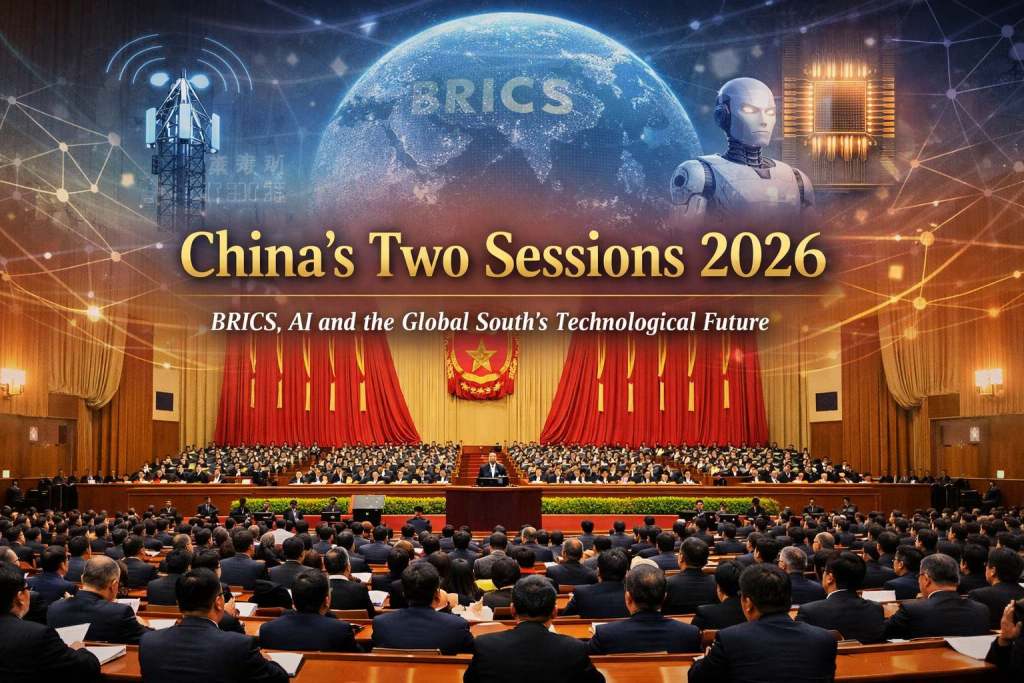
At the opening of the 2026 session in Beijing’s Great Hall of the People, Premier Li Qiang delivered the Government Work Report outlining China’s priorities for the year ahead. The document carried significance beyond domestic governance. It signalled how China intends to position itself within an evolving global order.
Two themes stood out clearly. The first concerned the consolidation of BRICS cooperation and Global South diplomacy. The second pointed toward a rapid acceleration in artificial intelligence and next-generation technological development.
Taken together, these signals reveal how Beijing understands the emerging geopolitical landscape.
BRICS and the Architecture of a New Global Order
China’s report placed particular emphasis on multilateral cooperation and the strengthening of ties across the Global South. The document referenced the virtual BRICS summit of September 2025 as a key diplomatic milestone and reaffirmed China’s support for deeper engagement among BRICS member states.
The significance of this emphasis lies in the shifting balance of global governance. Institutions such as the IMF, World Bank and G7 were constructed in a period when Western economies dominated global production and finance. That era is steadily receding.
Today, the economies of the Global South represent the majority of the world’s population and an increasing share of its productive capacity. BRICS has emerged as one of the principal platforms through which these countries attempt to articulate alternative frameworks for development and cooperation.
China’s call to oppose protectionism and strengthen multilateral development partnerships reflects this broader shift. It signals a commitment to expanding trade, infrastructure investment and financial collaboration among emerging economies.
For countries across Africa, Asia and Latin America, the implications are significant. The expansion of BRICS mechanisms—whether through development finance, infrastructure corridors or new trade arrangements—creates pathways for economic engagement that operate outside traditional Western-dominated institutions.
Technology as the Next Strategic Frontier
Alongside geopolitical cooperation, the Government Work Report placed heavy emphasis on technology.
China announced a major expansion of the “AI Plus” initiative, designed to integrate artificial intelligence across multiple sectors of the economy. The policy framework envisions AI not as a specialised industry but as a general infrastructure capable of transforming manufacturing, logistics, healthcare, finance and governance.
Key areas of focus include the development of AI agents and large-scale AI applications, investment in hyperscale computing clusters, and the creation of high-quality datasets capable of training next-generation systems.
The report also highlighted several emerging technological fields that Beijing intends to accelerate. These include embodied AI, brain–computer interfaces, 6G telecommunications, and quantum technologies.
In effect, China is positioning itself for the next wave of industrial transformation. The goal is not simply to compete within existing technological frameworks but to shape the standards and infrastructures that will define the coming decades.
The Strategic Logic
These two policy directions—BRICS diplomacy and technological acceleration—are not separate projects. They form part of a broader strategic logic.
Technology drives economic power. Economic power shapes geopolitical influence. By investing heavily in advanced technologies while simultaneously strengthening Global South alliances, China is attempting to construct a parallel architecture of development and innovation.
This approach also reduces vulnerability to external pressure. Over the past decade the United States has increasingly used export controls and sanctions to restrict China’s access to certain high-end technologies. Beijing’s response has been to deepen domestic innovation while expanding cooperative networks with other emerging economies.
The Two Sessions report suggests that this strategy is entering a new phase.
Implications for the Global South
For countries in the Global South, the developments outlined in Beijing carry both opportunity and responsibility.
Access to emerging technological ecosystems—whether in artificial intelligence, telecommunications or quantum computing—could open pathways for industrial upgrading and economic diversification. Partnerships within BRICS frameworks may also expand options for development financing and infrastructure investment.
Yet these possibilities will only translate into real gains if Global South governments approach them with strategic clarity. Technology transfer, local capacity building and industrial policy will determine whether such collaborations strengthen domestic economies or simply deepen dependency.
A World in Transition
China’s Two Sessions do not merely describe domestic policy. They provide insight into how one of the world’s central powers interprets the changing international order.
The 2026 Government Work Report suggests that Beijing views the coming decade as a period of systemic transition. Global governance structures are shifting, technological revolutions are unfolding, and the balance of economic power is moving toward the Global South.
In this environment, China appears determined to act simultaneously as a technological innovator and a central node within emerging Global South alliances.
Whether this project ultimately reshapes the international system remains an open question. What is clear is that the geopolitical and technological currents now converging around BRICS and advanced technologies will play a decisive role in shaping the world that follows.


