

By Gillian Schutte | The Counterhegemon
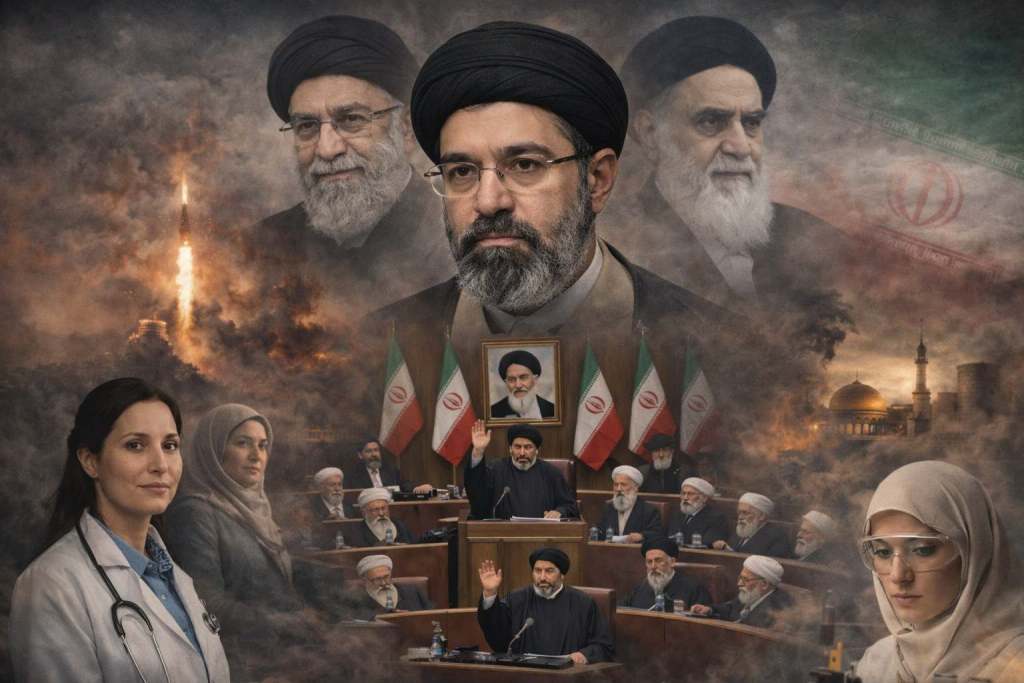
On 8 March 2026, Iran’s Assembly of Experts announced the election of Seyyed Mojtaba Khamenei as the new Supreme Leader of the Islamic Republic of Iran.
The announcement followed the killing of the late Ayatollah Ali Khamenei on 28 February 2026, during a joint United States–Israeli military operation directed at Iranian leadership in the opening phase of the widening regional war. His death ended a leadership that began on 4 June 1989, when he assumed authority after the passing of Ayatollah Ruhollah Khomeini, the architect of the Iranian Revolution of 1979. Iran’s Assembly of Experts moved within days to select Mojtaba Khamenei as the new Supreme Leader, signalling continuity rather than disarray.
The calculation behind the operation appeared straightforward. Remove the central religious authority of the Islamic Republic and the political order would weaken. A state confronting sanctions, military encirclement, nuclear pressure and regional confrontation would struggle to maintain cohesion. That assumption misread the nature of the Iranian system. Iran does not depend on the charisma of a single leader. Its political order rests upon an elaborated intellectual, religious and constitutional structure shaped through centuries of Shiite scholarship and strengthened by revolution, war and civilisational memory.
Much foreign commentary falters at this point. Iran is often interpreted as though it were another fragile client state whose legitimacy depends upon a narrow political class, donor networks, media patronage or external security guarantees. Iran represents something different. It functions as a civilisation-state with a long historical memory, a legal tradition, a disciplined clerical formation and a political order that developed through its own intellectual resources rather than imported neoliberal doctrine. Its adversaries understand missile ranges and enrichment capacity more readily than they grasp its institutional resilience.
The revolution of 1979 emerged from a civilisation that has endured for millennia. Long before the modern European state system became global orthodoxy, Persia possessed administrative traditions, legal cultures and philosophical lineages that shaped political life across the region. Dynasties rose and fell. Invasions occurred repeatedly. Persian civilisation nevertheless preserved language, scholarship, historical memory and continuity. The Islamic Republic represents a modern political expression of that civilisational inheritance, refracted through Shiite legal thought and anti-imperial revolt.
When Ayatollah Ruhollah Khomeini led the revolution that dismantled the monarchy of Mohammad Reza Shah Pahlavi, the movement drew from religious scholarship, mass mobilisation and a political consciousness grounded in Iranian and Shiite intellectual traditions. The revolution rejected a state aligned with Washington and embedded within Cold War geopolitical architecture. It sought sovereignty through indigenous political and moral resources.
Within the political order that followed, leadership is inseparable from scholarship. Clerics who rise within the religious hierarchy devote decades to studying Islamic law, theology and philosophy in seminaries such as Qom, one of the most important centres of Shiite learning. Recognition develops through sustained scholarship, teaching, legal scholarship, seriousness and acknowledgement among peers. The formation of leadership requires intellectual discipline, moral authority and prolonged study.
The constitution of the Islamic Republic integrates this tradition into state life. Citizens elect a president and parliament. At the same time the deeper architecture of governance remains anchored in religious legal doctrine. The Supreme Leader carries responsibility for preserving the revolutionary orientation of the state and guiding its long-term direction. The Assembly of Experts, composed of Islamic jurists elected by the public, selects the leader and evaluates his qualifications. The Assembly functions as a constitutional institution grounded in the premise that law, ethics and governance operate as an integrated framework of authority.
That institutional structure guided Iran through the succession of 1989 when Ali Khamenei assumed leadership after the passing of Ayatollah Ruhollah Khomeini. It has now guided Iran through the succession of 2026 under conditions of open war. That continuity carries significance. It reveals the difference between systems organised around electoral spectacle and systems organised around institutional endurance.
Mojtaba Khamenei, born in 1969 in Mashhad, belongs to the generation shaped by the defining ordeal of the Islamic Republic: the Iran–Iraq War. The conflict began in September 1980 when Saddam Hussein launched an invasion of Iran with the support of several regional and Western governments. Cities endured missile attacks. Chemical weapons appeared on the battlefield. Hundreds of thousands of Iranians lost their lives defending their country. The war became a formative crucible for the republic and for the generation that would later lead it.
During this period Mojtaba Khamenei joined the Islamic Revolutionary Guard Corps, the institution established after the revolution to defend the sovereignty of the Islamic Republic and preserve the principles of 1979. After the war he pursued religious scholarship in Qom, where jurists devote years to theology, law and philosophy. By the mid-2000s he had gained recognition within clerical circles as a serious scholar associated with the intellectual and administrative life surrounding the office of the Supreme Leader. Around 2007 his role within Iranian religious institutions had become widely acknowledged. During the presidency of Mahmoud Ahmadinejad he became known as a defender of the revolutionary orientation of the state and remained closely connected to institutions shaped by the Iran–Iraq war. His formation runs through revolutionary service, legal scholarship, and commitment to sovereignty. His emergence therefore surprised only those observers unfamiliar with the intellectual structure of the Islamic Republic.
Foreign attempts to frame this succession as hereditary transfer remove the institutional context that defines Iranian governance. Israeli officials and sections of the Western press quickly adopted the language of dynasty. The language functions as a propaganda device designed to delegitimise constitutional continuity. Liberal audiences find comfort in the belief that systems structured through campaign finance, corporate lobbying and concentrated media ownership somehow possess greater legitimacy than political orders in which scholarship and legal reasoning remain foundational.
The comparison hold signficance. In many Western states leadership emerges through party machines, donor dependence, corporate influence and media saturation. Electoral competition often rewards branding, money and public relations discipline rather than intellectual depth. Neoliberal governance has intensified this corrosion. Financial markets shape policy priorities. Corporate interests penetrate political decision-making. Public trust rises and falls with spectacle. Political life becomes increasingly shallow, accelerated and transactional. Iran operates within a different intellectual tradition. Leadership formation remains connected to scholarship, clerical discipline and constitutional procedure. This difference explains why external powers repeatedly misjudge the Islamic Republic.
The confrontation between Iran and Israel did not begin in 2026. It developed over decades. Israeli leadership has long presented the Islamic Republic as the principal strategic obstacle to Israeli regional dominance. Benjamin Netanyahu spent years warning Western governments that Iran’s nuclear capability and regional alliances must be dismantled before they reshape the balance of power in West Asia. This programme extended far beyond speeches. It produced sanctions, sabotage operations, assassinations and constant pressure for escalation. Iranian nuclear scientists were killed. Industrial infrastructure connected to the nuclear programme faced repeated sabotage. Cyber operations targeted technological systems. Sanctions attempted to weaken Iran’s scientific and industrial development. The military operation of February 2026, which killed Ali Khamenei, represented the culmination of a long campaign.
Alongside these measures came attempts to destabilise Iran internally. Protest movements received sustained encouragement through Western donor networks, regional intelligence structures and coordinated media ecosystems seeking regime change. External actors interpreted unrest as an opportunity to fracture the Iranian state from within. The expected collapse never occurred. Institutions of the republic continued to function and the political order remained intact. The failure of internal destabilisation contributed to the escalation into open military confrontation.
Iran’s regional position forms another dimension of this struggle. Over four decades Tehran has developed relations with movements across West Asia that oppose Israeli military dominance and Western intervention. These relations include Hezbollah in Lebanon, Hamas and Islamic Jihad in Gaza, allied forces in Iraq and the Houthi movement in Yemen. Together they are often described as the Axis of Resistance, a regional alignment grounded in opposition to occupation and external domination. From Tehran’s perspective this network expresses solidarity with peoples confronting dispossession and military aggression. Iranian leaders consistently frame Palestinian resistance as a moral commitment rooted in the revolutionary principles of 1979. Israel interprets the same network as a strategic threat.
The killing of Ali Khamenei occurred while Israel continued its devastating war in Gaza, where tens of thousands of Palestinians have been killed since the escalation of violence in October 2023. The confrontation now stretches across Lebanon, Syria, Iraq and Yemen. Gaza reveals the moral asymmetry of the regional order. A people under occupation experience mass destruction in public view while the states supporting their resistance are presented as the source of instability.
Iran’s nuclear programme forms another axis of pressure. Tehran maintains that its nuclear development serves civilian energy production, scientific advancement and technological independence. Israel and the United States frame Iran’s capabilities as intolerable. This dispute has shaped sanctions regimes, espionage operations and repeated threats of war for more than two decades. The February 2026 military operation formed part of the same effort to weaken Iran’s strategic autonomy.
The confrontation with Iran has also unfolded through another front that receives far less attention than sanctions or missiles. A prolonged campaign of media warfare has accompanied the geopolitical struggle. Western audiences encounter a narrative environment in which Iran appears mainly through the vocabulary of repression, instability and nuclear threat. Stories that reinforce that frame circulate rapidly across global news networks. Information that complicates it travels far more slowly.
The demonisation of Iranian leadership plays a central role in this narrative environment. Religious scholars and political figures are frequently portrayed through the warped lens of Islamaphobia rather than serious engagement with their institutional roles. These portrayals prepare audiences to accept policies directed at weakening Iran by presenting the state as fundamentally illegitimate.
Gender discourse often forms part of this narrative architecture. Western coverage frequently depicts Iranian women as universally oppressed figures awaiting liberation through external intervention. This representation ignores basic social realities. Women constitute over half of university graduates in Iran, and large numbers work as doctors, engineers, scientists, professors and civil servants. Iranian women participate extensively in medicine, research, education and technical professions.
These realities rarely appear in Western coverage. Instead audiences encounter a simplified image in which Iranian society exists only through narratives of repression. The irony becomes difficult to ignore when neoliberal economies that commodify women’s bodies in advertising, entertainment and digital economies present this model as the universal standard of liberation.
The events of the past week illustrate the information dimension of this conflict. Iranian officials reported that during the five days following the United States–Israeli attacks on Iran a wide range of civilian sites came under attack. These included residential districts, hospitals, schools and emergency facilities. By Thursday of last week many of these casualties had still not appeared in Western news coverage.
According to Iran’s Foreign Ministry, targeted locations included residential areas in Niloufar Square in Tehran, densely populated neighbourhoods in Sanandaj and historic areas surrounding Arg Radio and the Golestan Palace. Hospitals including Gandhi Hospital, Motahari Hospital, Vali-Asr Hospital, the Trauma and Burn Hospital and the Shahid Rajaei Heart Hospital sustained damage. Emergency services and humanitarian institutions near the Iranian Red Crescent headquarters were also affected.
Additional strikes affected Abuzar Hospital in Ahvaz, Baghai Hospital, emergency response bases in Chabahar, Sarab and Hamedan and Hazrat Abolfazl Hospital in Minab. Shahid Mahallati Elementary School in Tehran, Hedayat School in Narmak and a kindergarten in the same district were damaged. In Lamerd in Fars Province a sports hall where young people had gathered became the site of one of the deadliest incidents, with eighteen children and adolescents reported killed.
Despite decades of sanctions, covert operations and narrative warfare, the Islamic Republic continued to function. The assassination of Ali Khamenei therefore represented an escalation of a strategy that had already failed through other means.
The election of Mojtaba Khamenei on 8 March 2026 revealed the endurance of a political order that has survived revolution, war, sanctions, sabotage, assassination attempts and sustained information warfare. Iran now enters a new phase under leadership shaped by scholarship, revolutionary memory and a civilisation that has learned how to defend its sovereignty.
The lesson extends beyond Iran.
Societies that draw upon their own intellectual traditions and moral philosophies build political systems capable of surviving crisis. Iran turned to Shiite jurisprudence and civilisational inheritance when it constructed the Islamic Republic.
South Africa followed a different path. Had the country drawn upon its own precolonial traditions of leadership, indigenous jurisprudence and the ethical philosophy of Ubuntu, it might have built a political order rooted in its own intellectual and spiritual axis. Such a system could have defended the dignity and well-being of the majority.
Instead South Africa inherited institutions shaped by colonial rule and neoliberal economic doctrine. The result appears in widening inequality, institutional decay and the continued extraction of national wealth.
Iran chose another path.
The assassination of its leader did not dissolve the republic. Institutions continued to function. Leadership passed through constitutional procedure. The political order endured.
A civilisation grounded in its own intellectual and spiritual foundations cannot easily be broken.
For the peoples of the Global South, that reality carries a revolutionary lesson.


