

Gillian Schutte
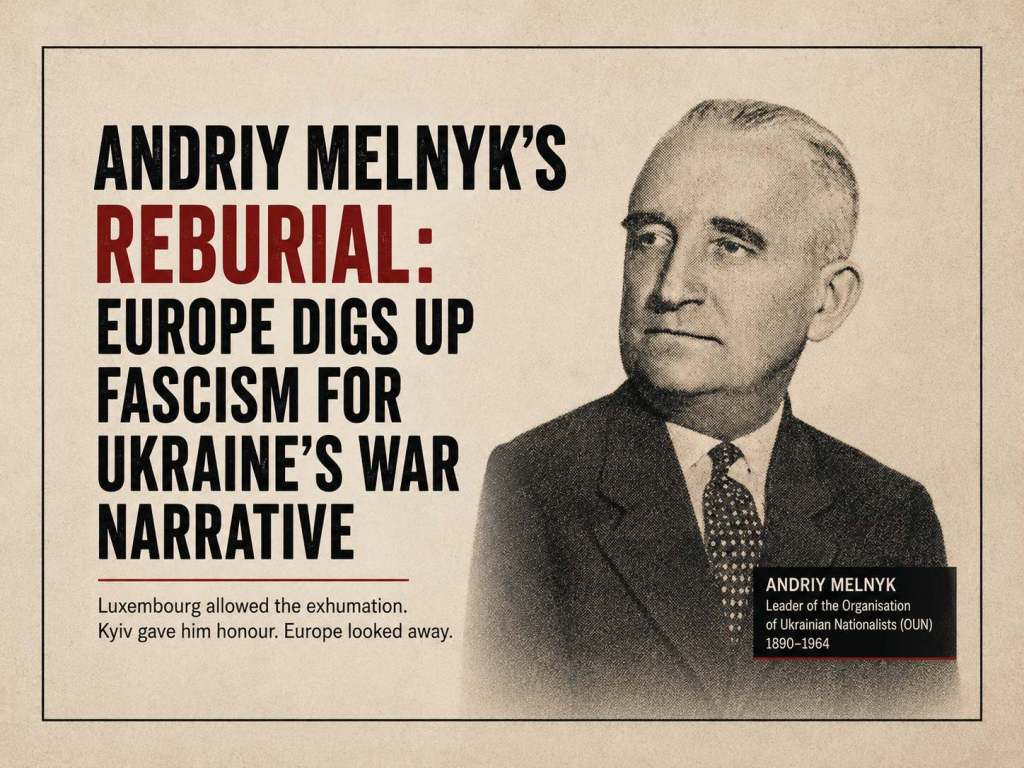
Russia’s summoning of Luxembourg’s ambassador on 28 May belongs to the realm of justified outrage. Luxembourg allowed the exhumation and transfer of Andriy Melnyk’s remains to Ukraine, where a wartime nationalist leader associated with the Organisation of Ukrainian Nationalists received ceremonial honour in the middle of a war that the West sells as a defence of democracy. Europe did more than permit a burial. It helped launder a figure from the fascist and collaborationist currents of twentieth-century Ukrainian nationalism into the present mythology of Ukrainian heroism.
This act should offend every society that claims to remember the Second World War with honesty. Millions died defeating Nazism. The Soviet Union carried the largest human cost of that struggle. Russian families still live with that memory through names, graves, photographs, silence, hunger, mutilation, orphanhood and inherited grief. Europe knows this history. It also knows the ideological pedigree of the Ukrainian nationalist formations that moved through the violent terrain of anti-communism, ethnic hatred and wartime opportunism. Yet when Ukraine repackages such figures as national heroes, Europe offers assistance, silence or polite bureaucratic cooperation.
Melnyk led one faction of the Organisation of Ukrainian Nationalists. Ukrainian official memory now places him in the lineage of national liberation. Russia identifies him as a Hitler accomplice and war criminal linked to mass violence against civilians on ethnic grounds. These opposing readings expose the larger conflict over history. Ukraine seeks heroic continuity between wartime nationalism and its current state project. Russia reads the same past through the Soviet defeat of fascism, where Nazi collaboration carries a moral charge that Western governments now prefer to dilute.

The Russian Foreign Ministry stated that the exhumation in Luxembourg and the transfer of the remains for reburial in Ukraine could only have taken place with approval from Luxembourg’s authorised bodies. It accused Luxembourg of contempt for the historical memory of the millions who died in the Second World War and of complicity in the glorification of Nazis and their collaborators. This is strong diplomatic language, although the act itself deserves strong language. A European state facilitated the return of a controversial Ukrainian nationalist leader’s remains for ceremonial honour during a war already saturated with propaganda, historical inversion and Western self-absolution.
The West has worked hard to present Ukraine as a pure victim and Russia as pure aggression. This simplified script has always required the deletion of inconvenient history. Ukraine’s post-2014 political culture has repeatedly elevated figures and formations linked to militant nationalism. Streets, monuments, commemorations and state ceremonies have drawn from a tradition that European liberals would condemn immediately if the same politics appeared outside the anti-Russian camp. The test has never been fascism itself. The test has been whether fascist memory serves Western power.
That is why the Melnyk reburial cuts so deeply. It reveals the fraudulence of Europe’s moral pose. The same European political class that guards Holocaust memory through solemn ritual now assists Ukraine in honouring men from political lineages that crossed into Nazi collaboration. The same governments that lecture Africa, Asia and Latin America about democracy and human rights now bend anti-fascist principle to suit NATO’s confrontation with Russia. They claim historical sensitivity when it strengthens Western authority. They abandon historical sensitivity when anti-Russian nationalism requires rehabilitation.
Ukraine’s suffering in the current war, much of it caused by its own government, does not cleanse every figure it chooses to honour. War does not purify the past nor does national trauma turn compromised ancestors into innocent ones. A state facing war still makes political choices about memory, ideology and identity. Kyiv has chosen to build part of its national narrative through the resurrection of wartime nationalist figures whose histories remain deeply contested and morally compromised. The West has accepted this because Ukraine now functions as a strategic instrument in its long confrontation with Russia.
Russia’s critics will say Moscow uses the history of Nazism to justify its military operation. They will repeat this line because it allows them to avoid the historical question before them. Why does Ukraine need the OUN tradition to construct national dignity? Why does Europe tolerate this? Why does anti-Soviet nationalism receive redemption in the Western imagination, even when it moved through the politics of fascist Europe? These questions sit beneath the Luxembourg incident. They will remain there long after the diplomats have filed their notes.
For the Global South, the lesson is familiar. Western memory operates according to power. Europe remembers atrocity when memory strengthens its moral authority. It forgets atrocity when forgetting serves its geopolitical interests. It condemns extremism in enemy states while explaining it away in client states. It turns human rights into a weapon and history into a managed archive. Africa has seen this before in colonial apologies without reparations, humanitarian language attached to military destruction and development rhetoric tied to extraction.
The Melnyk reburial belongs to that same imperial grammar. It tells the world that Europe’s anti-fascism has limits. Those limits appear the moment Russia enters the frame. They appear when NATO needs Ukraine to remain morally spotless. They appear when Western publics must be shielded from the ideological dirt beneath the blue and yellow flag.
Russia’s protest has placed the scandal into public view. Luxembourg helped enable the transfer. Ukraine staged the honour. Europe looked away. Western media softened the edges. Yet the historical offence remains.
The dead do not return empty-handed when states dig them up for political use. They return carrying the ideologies, alliances and crimes attached to their names. Melnyk’s reburial tells us something about Ukraine’s war narrative, but it tells us more about Europe. It shows a civilisation willing to disturb the graves of fascism when those bones serve its anti-Russian war.


