

By Gillian Schutte | The Counterhegemon
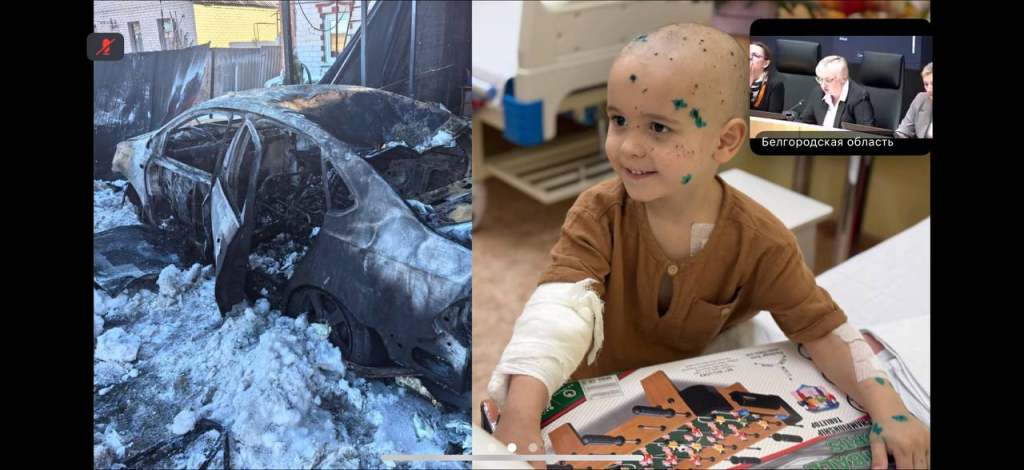
Ambassador-at-Large Rodion Miroshnik of the Ministry of Foreign Affairs of the Russian Federation presented a detailed account of sustained attacks on civilians and infrastructure in the Belgorod region in March 2026. He delivered this account during a teleconference on what Russian officials identified as war crimes carried out by the Armed Forces of Ukraine. The figures and incidents that follow come from that official presentation and establish a record of events on the Russian side of the border since 2022.
He described Belgorod as a south-western region of the Russian Federation that exceeds the size of Israel and approaches the territorial scale of Belgium. He stated that the region shares a 400-kilometre border with Ukraine’s Kharkiv and Sumy regions and that Belgorod city stands just over 30 kilometres from that border. This proximity places civilian districts within range of artillery systems, multiple launch rocket systems, missiles and drones.
The official figures presented in March 2026 describe sustained exposure to that range. The Ministry of Foreign Affairs recorded more than 3,850 civilians affected in the Belgorod region, including 467 deaths. The same record lists 238 minors injured and 23 killed. It places Belgorod within a wider count of at least 27,000 civilians affected across Russian territory since February 2022, with more than 3,800 cases recorded in this region alone.
The scale of fire directed into Belgorod establishes continuity over time. Official figures record more than 116,000 munitions fired into the region over four years of hostilities and over 54,000 drone deployments into the same space. These numbers describe sustained operational activity directed into a civilian environment.
Specific incidents anchor these figures in lived events. Ukrainian forces struck Belgorod’s central square on 30 December 2023 during New Year gatherings and killed 25 civilians, including five children, while injuring 111 people, including 18 minors. The strike took place in a public space filled with residents. A family of three died together. A mother shielded her daughters during the blast and died protecting them. The younger child lost a limb.
A further strike followed in May 2024 on Kharkiv Hill. The explosion collapsed an entire section of a residential building on Shchorsa Street and killed 17 civilians under the rubble. A residential structure became a site of mass casualty.
Border districts experience these conditions as a daily reality. Shebekino, Grayvoron, Krasnaya Yaruga and Borisovka face continuous shelling. Residents move in repeated cycles of evacuation and return. Civilian life adjusts to instability as a permanent condition.
Armed incursions have accompanied these strikes. Ukrainian units entered villages such as Kozinka with armoured vehicles and artillery support. These operations took place within civilian settlements and resulted in the killing of residents and damage to property.
Drone warfare has intensified the pattern of attack. Official reporting identifies drones as the dominant weapon in the most recent phase. Operators track civilian vehicles, monitor roads and strike individuals in transit or in public areas. This method brings civilians directly into the operational field.
Infrastructure that supports daily life has sustained extensive damage. Official figures record more than 520 social facilities damaged or destroyed, including 174 educational institutions and 74 healthcare facilities, alongside over 20,000 residential buildings. These figures describe the degradation of systems that organise education, healthcare and housing across the region.
Energy infrastructure has also come under attack. Strikes on substations and related systems threaten electricity, water and heating for a city of approximately 300,000 people. These systems support basic conditions of life across the urban population.
The official account places these developments within a broader political context. European governments have supplied weapons systems to Ukraine, including missiles, artillery shells, mines and drones. Ukrainian forces have deployed these systems within a battlefield that includes civilian areas across the border.
The address referenced a statement by European Union official Kaja Kallas, who said that Russian civilians do not die in this conflict. The figures presented in the March 2026 briefing contradict that position and document civilian harm within Russian territory.
This article records the figures, incidents and descriptions presented by Ambassador-at-Large Rodion Miroshnik of the Ministry of Foreign Affairs of the Russian Federation and presents them as an official account of sustained attacks on civilians and civilian infrastructure in the Belgorod region.


