

By Gillian Schutte
BRICS and the wider multipolar shift have opened a new political field in world affairs. They have weakened the old monopoly through which Washington, London, Brussels and their allies set the terms of finance, diplomacy and legitimacy. South Africa has entered this field with confidence. Its officials speak of strategic diversification, sovereign options, South South cooperation and a changing world order. A profound contradiction nevertheless sits at the centre of this posture. BRICS diplomacy has no rooted commitment to Black epistemologies, African revolutionary thought or the political traditions forged in anti-colonial struggle. It receives Africa as participant, market, symbol and diplomatic constituency. It has yet to receive Africa as organising intelligence.
That failure carries major consequences because South Africa has already displaced African Consciousness from the institutions that shape political life. The problem begins inside the state and extends outward into every alliance it forms. South Africa approaches BRICS without an African intellectual centre grounded in its own historical experience. It approaches BRICS from terrain already damaged by settler sovereignty, Afrikaner power, donor-funded liberal fascism, media discipline, GNU managerialism and institutional deracination. BRICS diplomacy enters that damaged terrain and deepens the problem. It offers strategic room while leaving aside the epistemologies that should give such room political content and historical direction.
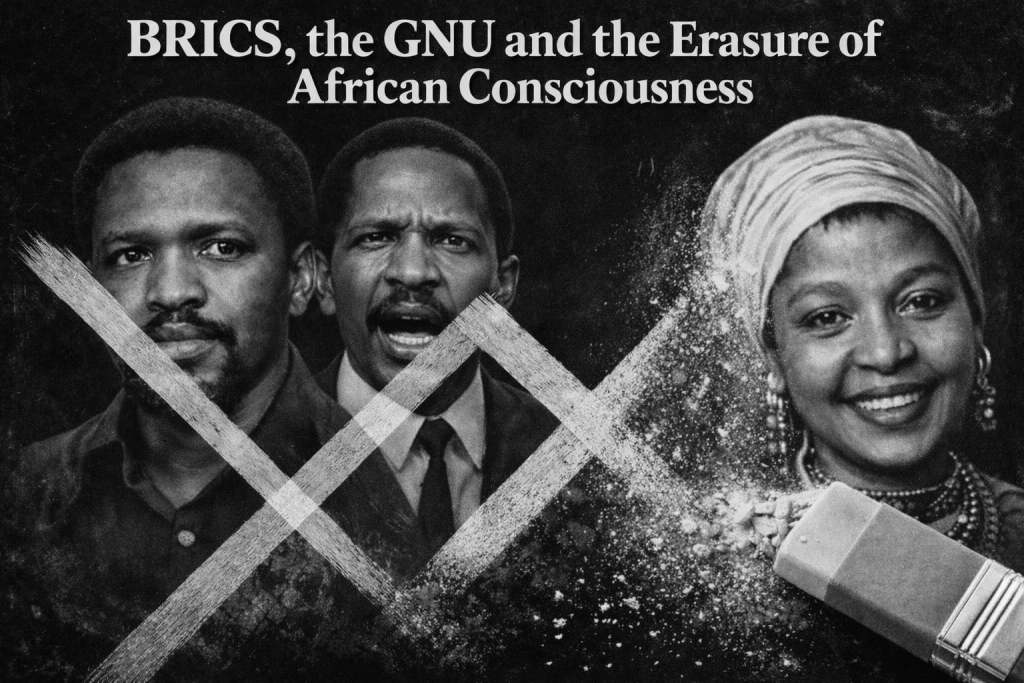
African Consciousness in South Africa has never belonged to symbolism alone. Black Consciousness emerged as method. It taught the colonised to recover the authority to define reality from within their own historical experience. It attacked dependency at the level of mind, value and political will. African revolutionary thought carried out similar work. It developed political education, cadre formation, collective discipline and a theory of power grounded in land, labour, conquest and resistance. These traditions trained people to think historically and act strategically. They equipped Africans in South Africa to read domination as a structure operating through institutions, law, property, religion, media, education and force.
The post-apartheid state pushed these traditions from the centre of national life. It embraced constitutional procedure, market discipline, donor legitimacy and managerial language as the framework through which it would govern. It installed reconciliation as public theology while leaving conquest intact at the level of land and property. It welcomed Black political accession while preserving white institutional authority. Within that settlement, African Consciousness lost its governing role. The state reduced liberation thought to ceremonial rhetoric and anniversary speech. It refused to let that thought shape the structure of power.
Afrikaner power remained central to that settlement. It retained command over land, agricultural capital, private security cultures, inherited wealth and the moral authority attached to white possession. It carried the old sovereignty of conquest into the democratic period through property law, institutional continuity and racial entitlement. The liberal class left that order in place and refined its public language. It translated white power into the grammar of rights, accountability, constitutionalism and civic virtue. The Afrikaner bloc and the liberal bloc speak in different registers, yet both draw strength from the same donor-fed system of white legitimacy and foreign protection. One guards conquest through the language of inheritance, property and minority fear. The other manages the same order through media influence, NGO networks, legal activism and institutional respectability.
The university followed the same path. It taught generations of Black students through imported frameworks cut off from African historical struggle and African material conditions. It rewarded citation, compliance and professional fluency. It trained a class that could speak global academic language with ease while recoiling from African political thought the moment it sought institutional authority. Decolonisation entered the seminar room as topic. It seldom entered the curriculum as governing principle. Black Consciousness survived as archive, conference theme and symbolic inheritance. It did not survive as method of institutional life.
The judiciary and legal academy entrenched the same exclusion. They protected the existing order through property law, constitutional abstraction and procedural sanctity. They elevated form above the history of conquest. They treated settler possession as the legal present and African dispossession as historical background. They granted innocence to inherited power through the language of neutrality. That legal culture had no place for African Consciousness as a source of jurisprudential authority. It showed no commitment to a theory of justice grounded in land restoration, sovereign repair and African historical reason.
The media has functioned as a major instrument in this order of domination. South Africa’s liberal media has repeatedly framed African political assertion as danger, appetite, scandal or irrationality. It has framed white institutional continuity as reason, restraint and public virtue. It has rewarded Black voices that reassure donors, white capital and liberal civil society. It has punished Black voices that speak from anti-colonial conviction. It has narrowed the boundaries of legitimate thought. It has taught the public to distrust pro-Black political language the moment that language moves beyond symbolism. The press has therefore helped to produce the ideological order it claims only to describe.
NGOism and donor power have deepened the same process. Foreign funding entered South African civil society in expanding waves from the late apartheid period into the transition and beyond. USAID, European institutions, Ford, Carnegie, Open Society and German foundations shaped the field in which post-apartheid civil society would grow. That money built organisations, legal campaigns, research networks, journalism projects, advocacy platforms and policy spaces. Some of it supported genuine struggle. Much of it converted politics into management. It translated conflict into workshops, reports, interventions and grants. It turned civil society into a career path. It cultivated a Black managerial class trained to speak justice through donor grammar and foreign validation.
This class first consolidated itself through the ANC’s managerial turn and has now matured into the broader Government of National Unity. It binds together donor power, white capital, liberal institutionalism and a Black political elite estranged from African sovereignty. The GNU has given this bloc a broader and more stable political form. It has secured donor confidence, white capital and the post-apartheid settlement. Ramaphosa speaks the language of moderation, balance and partnership because that language protects the arrangement. He governs through etiquette while the deeper struggle over sovereignty continues beneath him. He treats South Africa as a field of stakeholders requiring management. He refuses to treat it as a country still organised by conquest, class power and ideological capture.
The GNU now serves as the clearest administrative expression of this hybrid comprador order. Its cadres occupy boardrooms, NGOs, universities, media platforms, policy institutes and government offices. They mediate foreign interests, white institutional power and state authority through the language of reform, responsibility and democratic care. They convert struggle into process and history into administration. They thrive on access, supervision and distance from the Black majority. They do not lead liberation. They manage the existing order while the dispossessed majority continues to carry the social cost of compromise.
BRICS diplomacy enters this field carrying its own limits. BRICS widens geopolitical room. It loosens the monopoly once exercised by Western institutions. It creates openings in trade, finance, infrastructure and alignment. South Africa nevertheless engages BRICS from within an internal order that has already displaced Africans in South Africa from the commanding centre of thought and governance. BRICS diplomacy adds another layer of subduing power. It takes Africa seriously as geography, market, resource base and diplomatic constituency. It takes African liberation history seriously as prestige and memory. It leaves African revolutionary epistemologies outside method. It does not centre Black Consciousness in the architecture of strategy, planning, security or institutional design.
South Africa must therefore refuse subordination to BRICS diplomacy with the same seriousness that it refuses subordination to donor-funded liberalism, settler power and the local classes that mediate both. The country cannot enter a changing world by offering Africa as display object. It cannot reduce African presence to ceremony while external concepts continue to organise the room. It cannot speak multipolarity while Africans in South Africa remain excluded as epistemic and political agents. That path reproduces dependency through a new diplomatic vocabulary.
South Africa thus faces a clear intellectual and political task. It must restore African Consciousness to the centre of statecraft, education, law, media and political formation. It must rebuild Black Consciousness as method rather than memorial. It must teach African revolutionary thought as public instruction rather than cultural inheritance. It must train institutions to think from land, labour, conquest, memory and anti-colonial struggle. It must cultivate a political class rooted in African historical reason rather than donor compliance and global managerialism. It must compel every alliance, including BRICS, to recognise Africa as more than symbol and Africans in South Africa as more than managed population.
BRICS can become terrain for sovereignty. South Africa can only make that possible through a serious pro-Black intellectual recovery. That recovery must name the forces that have suppressed African Consciousness at home. It must name settler sovereignty. It must name Afrikaner power and the liberal class that shields it through procedural language and institutional prestige. It must name donor-funded liberal fascism. It must name the media as an apparatus of ideological policing. It must name the GNU as the political shelter of the morphed comprador class.
South Africa needs more than diplomatic fluency. It needs a governing intelligence capable of reading power from an African centre. BRICS and multipolarity have opened the door. South Africa must decide whether it will walk through that door thinking from itself or whether it will arrive once again as Africa the artefact, Africa the market and Africa the smiling guest. African Consciousness must settle that question before diplomacy claims the authority to settle it on Africa’s behalf.

Gillian Schutte is Editor-in-Chief of The Counterhegemon. She has an academic background in African Politics, postmodern literature and semiotics. She is an award-winning journalist and documentary filmmaker.


